An idea or a sketch
Develop the shape, size, and features around how it will be used. Useful for new parts, accessories, and early product prototypes.
It starts with “what if?”
We work out the shape.
DDA develops 3D CAD models and technical drawings for custom parts, prototypes, and replacement components. Start with an idea, sketch, measurements, or an existing object. Take the design files to your own fabricator, or have us 3D print the part.
A sketch, a sample, or a description is enough to start.
YOU DO NOT NEED A FINISHED FILE
The starting point changes the work. The goal stays the same: a design that does the job you need.
Develop the shape, size, and features around how it will be used. Useful for new parts, accessories, and early product prototypes.
Measure and reconstruct an existing component, then discuss the changes needed. Useful for replacement parts, adapters, and discontinued pieces.
Review an existing model or drawing for the next step: a different fit, a revised feature, or a version intended for 3D printing. File compatibility is checked first.
FROM AN EXISTING OBJECT
Some shapes are difficult to capture with a few measurements. 3D scanning can provide surface geometry to use as a reference when reconstructing a part in CAD.
A scan is not automatically an editable CAD model. Reconstruction and checks of critical dimensions may still be needed. For simple geometric parts, direct measurement may be the more practical starting point.
DDA WORKSHOP PROJECT / TELESCOPE ACCESSORY
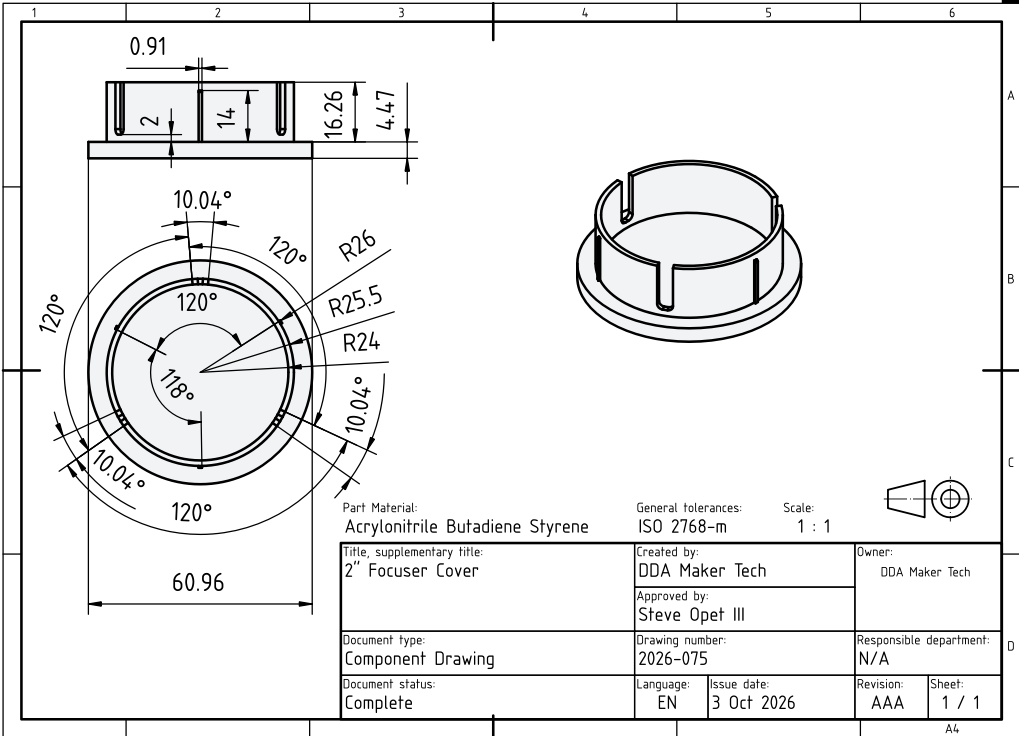
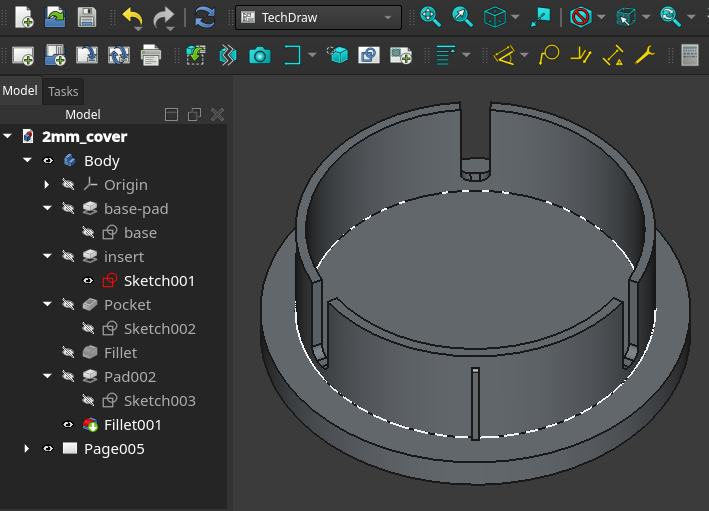
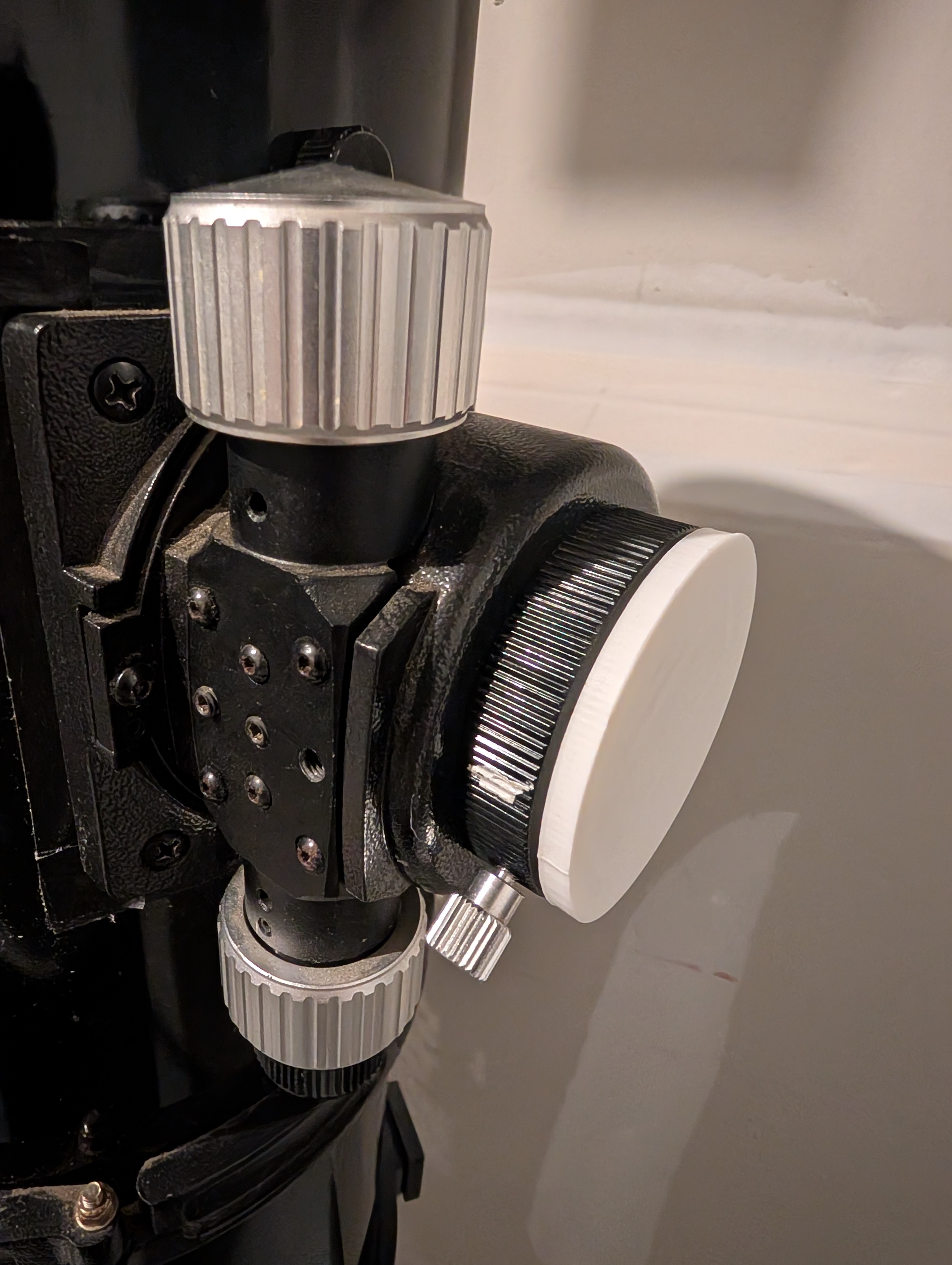
A custom cap for the 2-inch Crayford focuser on a telescope. The project moved from a CAD model and drawing to a printed part, with revisions informed by checks on the actual focuser.
ON THE TELESCOPE
THE PRINTED PART
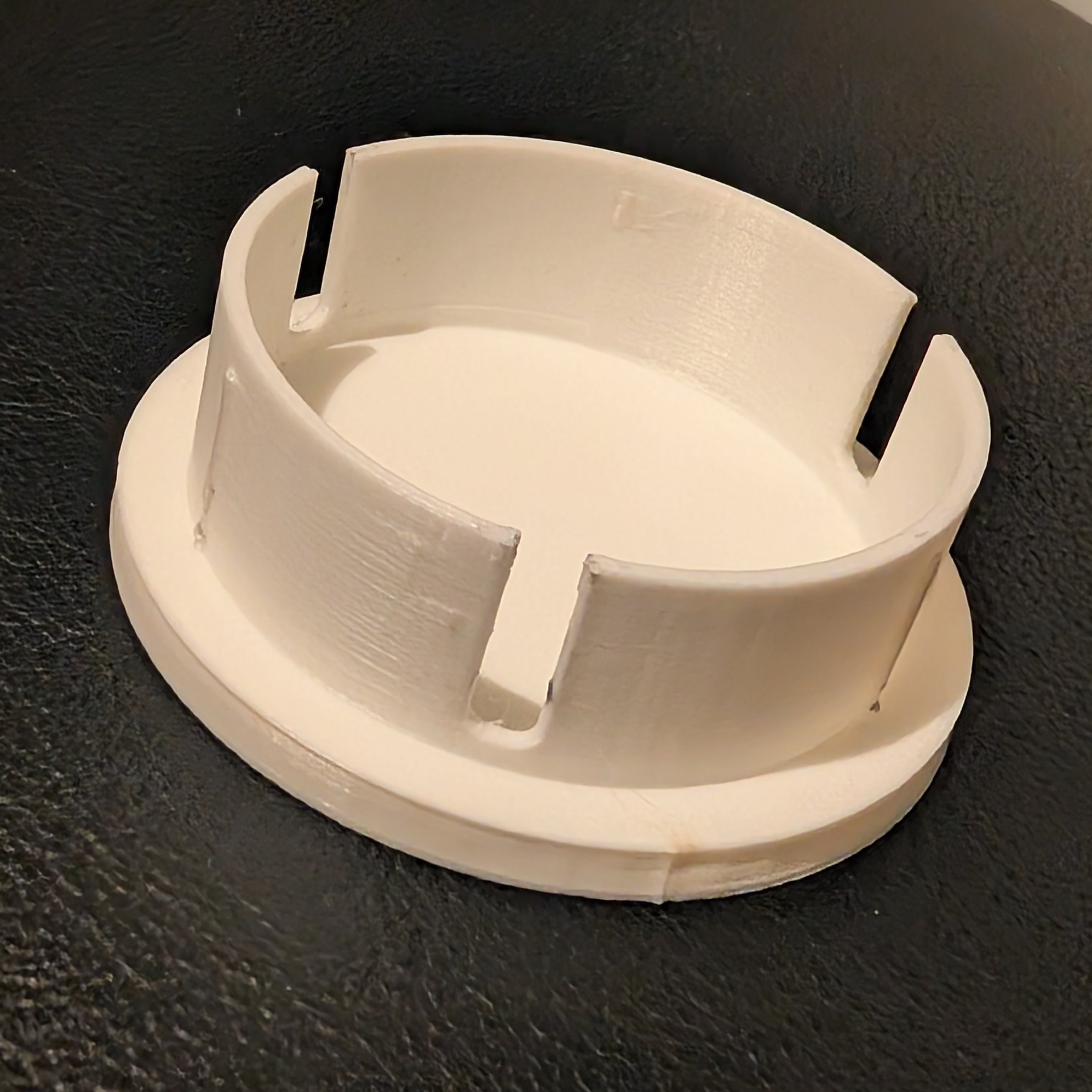
Early fit checks showed that the initial dimensions needed revision. The model was updated and reprinted over several iterations before arriving at the cap shown on the telescope.
The useful lesson: a nominal 2-inch opening is a starting point. The actual interface and the printed result still need to be checked.
The drawing records the cap’s geometry, including its radii, heights, flange, and slots. The model defines the shape; the physical fit check shows where it needs refinement.
Need only the design? That is a complete project too. We can discuss a handoff for your own equipment or another fabricator.
WHAT MAKES THE DESIGN WORK
CAD defines the geometry. The useful work is deciding what that geometry needs to do.
A shaft, fastener, mating part, or available space. Measurements at these interfaces matter more than a photo of the overall shape.
Locate, hold, protect, slide, or flex. Load, movement, heat, and wear help determine the features and material worth considering.
Wall thickness, orientation, clearances, and assembly can change with the process. A design intended for 3D printing needs that context from the start.
PLAN THE HANDOFF
Choose the next step to see what to discuss. The deliverables, formats, and revision scope are agreed before work begins.
FOR A PHYSICAL PROTOTYPE
Discuss the printer or printing service, material, quantity, and what the first part needs to demonstrate. A print tests only the conditions you actually check.
FOR ANOTHER FABRICATOR
Ask the shop which formats and drawing details it needs before the design is finalized. The manufacturing process and shop requirements shape the handoff.
FOR THE NEXT REVISION
If the part is still evolving, identify the dimensions or features likely to change. Discuss source-file delivery and software compatibility alongside the exported model.
FROM FIRST CONVERSATION TO FIRST VERSION
Design time depends on the geometry, the information available, and the decisions still to be made. Printing and revisions need a clear scope too.
What must the part do? What does it fit? What files, samples, or measurements do you have?
Discuss design work, deliverables, reviews, cost, and timing. Identify missing measurements before they become assumptions.
Review the design against the agreed requirements. If a prototype is included, use it to inform any agreed revisions.
CAD DESIGN / PRACTICAL ANSWERS
Yes. A sketch or description is enough to begin the conversation. To develop the model, we work out the dimensions, intended use, mating parts, and other requirements needed for the agreed design.
We can assess an existing component for measurement and CAD reconstruction. Access to the part, its condition, and the accuracy required determine the approach. Photos help with an initial review; they do not establish every dimension.
Not always. A simple part may be modeled from measured dimensions. Scanning can help capture more complex surfaces, but the resulting surface data may still need CAD reconstruction and checks of critical dimensions. We can discuss which approach fits the object and the result you need.
No. You can commission design work on its own. Tell us whether you will use the files yourself or send them to another fabricator so we can agree on a suitable handoff.
The deliverables are agreed for your project. Discuss whether you need a 3D model, print file, editable source model, or dimensioned drawing, and tell us which software or fabricator will use them. Different file types preserve different information.
We can review the file and the change you need. A mesh such as STL does not contain the same design information as an editable CAD model. Some changes may require rebuilding geometry rather than adjusting an original feature.
Cost depends on complexity, the information supplied, required drawings and file formats, and the review or revision scope. Share what you need and any budget or deadline. We discuss scope, cost, and timing before work begins.
Yes. DDA supports clients in New Jersey, New York, Pennsylvania, Delaware, and across the Northeast. Design discussions and file delivery can often be handled remotely. Projects involving an existing object may require shipping or arranging access for measurement.
LET’S LOOK AT THE IDEA
Tell us what it should do and what you have so far.
Missing details? Start with what you know.